Sunday, February 15, 2009

When I Was in 'Nam: Take Seven: Making it Through the Mekong Delta

The next leg of our trip was heading through the Mekong Delta region of Vietnam, although it ended up being more of a thigh because the time spent there was cut way too short. The Mekong Delta is referred to as Vietnam's 'rice basket' what with their contribution to establishing Vietnam as the world's second largest rice exporter. I really wanted to take a few days to really take it all in and do a homestay with the famously friendly and easygoing people who have used the Mekong River for generations to sustain their lives. That vision got nixed though and we ended up essentially just trying to make it through the region in time to get a ferry transfer to an island. It was rushed and crazy just trying to make it happen, but even in the fury the Mekong Delta made a mark on my memory.

Lots of time in the bus commuting, starting out at the gorgeously green rice paddies.

Random duck 'farm'.

From Ho Chi Minh we headed to Ben Tre for a little afternoon tourist-rific trip down the Mekong River.


We hopped off with the tour at little 'village', which I don't think anyone actually lived in. It seemed to be a community purely in existance for tourism, with little activities and sights to amuse. I was amused, but not incredibly impressed. I can't believe I was this close to bees. I hate bees. But I do love the fruits of their labor! The honey on this hive was delicious!

Go ahead - touch and hold the big scary snake!

Below is a picture of durian. It's a fruit that grows in south-east Asia and had become somewhat of an urban legend for me after hearing about it from so many fellow backpackers and friends. Yes, this durian had become the topic of many a conversation, debate, and dream for me. It's said to have a terrible, appalling, and sometimes illegal scent that turns many off to the fruit before they've even tasted it. But I had also heard that should one be brave enough to forego the raunchy smell and delve into the flesh of the fruit, they would be greatly rewarded with a little taste of heaven.
I finally spotted said durian in it's "natural habit", as seen below.
That one was not for the taking, but I fiiiiiinally got my opportunity to try the infamous fruit that night in Can Tho. I manned up and splurged on the fruit the size of my head. I haven't a clue as what is the proper way to choose a good durian, so I just pointed to the bunch and asked the fruit shop lady for one. She proceeded to go to town on shelling it and sorting it into a container.
The fruit was not NEARLY as retched smelling as I had been told. I was actually a little disappointed about that. Didn't seem like a such a feat without thinking I was going to vomit from the smell. I kindly allowed Brooke and Kristine to have the first samples. After they gave the okay, I dug in.
There were big 'ol seeds inside that the very ripened, green-ish yellow, avocado-esque, flesh loosely clung to. No need for utensils as we just dug our fingers into the gooey mess. I found it really tough to describe the taste and texture of it, so I conveniently found another dude's quote after his first experience with durian which hit the nail on the head for me:
"A rich custard highly flavoured with almonds gives the best general idea of it, but there are occasional wafts of flavour that call to mind cream-cheese, onion-sauce, sherry-wine, and other incongruous dishes. Then there is a rich glutinous smoothness in the pulp which nothing else possesses, but which adds to its delicacy. It is neither acid nor sweet nor juicy; yet it wants neither of these qualities, for it is in itself perfect. It produces no nausea or other bad effect, and the more you eat of it the less you feel inclined to stop. In fact, to eat Durians is a new sensation worth a voyage to the East to experience. ... as producing a food of the most exquisite flavour it is unsurpassed"
(Alfred Russel Wallace, 1856).

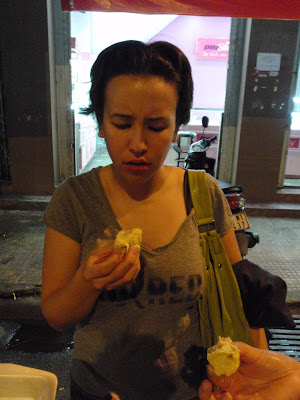
While I don't entirely agree with this British naturalists rave review, his description is so true. I'd say it was good, very good. Looks like Brooke would say otherwise.
Okay, back to Ben Tre. After playing with bees, snakes, having tea, sampling some fresh non-durian fruit, and listening to some local folk music, we got back onto the river. This time, it was on quaint little canoes. We actually ended up seeing the same cool chicks from England we had met on the Cu Chi Tunnels tour and loaded up together. For some reason, five foreign girls on a canoe in Vietnam produces a large desire to belt out animated Disney movie song lyrics. The Vietnamese were not amused.
Back on the Mekong River.

Even though the activities for the tour were pretty corny, our tour guide was absolutely fantastic. If I can demonstrate half as much enthusiasm as he did on the job, I will be a great, or at least an incredibly outgoing, teacher. Here he is explaining how coconut candy is made. I don't know if he actually cares about coconut candy that much, but I totally bought it. 12 packs worth of it.

This guy's job is to sit and stir the liquefied coconut for about 30 minutes until it's ready to lay out and cool before slicing and dicing it.

By night we had made it over to Can Tho. We got there with just enough time to experience durian, get dinner, eat ice cream, play with Ho Chi Minh, and squeeze a nap in before our 3am rise.

Thursday, February 12, 2009

When I Was in 'Nam: Take Six: The Result of a 'Nam Soccer Victory

Just before the New Year, families and friends all gathered round the TV. Not to watch the Christmas Parade or the New Year`s Countdown, though. They were gathered in the masses to watch the Suzuki Cup `08 Soccer Game. Totally unknowing, we got back pretty late from the full day tour, had to find accomodation since ours was conveniently no longer available, and headed out immediately for some grub. Or at least, that was the plan.
UNTIL we realized that every shop, bar, and home we passed had individuals 7 to 70 years old gazing at the boob tube. We finally walked into this one hotel to see what the fuss was all about, and caught this on the screen:
It was the final winning goal for Vietnam to beat Thailand in the finals of the Suzuki Cup, 3-2! Everyone in the lobby went absolutely nuts while we struggled to figure out what was going on. We were excited they were excited, but had no idea what was about to ensue.

The local park was all decked out in lights anyway and the people were out and about.

New Years Decorations were up and glorious.

And then THIS happened:

I could totally care less about football (what we Americans , but no one else in the world, refer to as soccer) on an international (or local for that matter) level. BUT, the enthusiasm and vibe that night after that win was incredible. It seemed as if all six and a half million people in Saigon were gathered within the streets armed with a Vietnamese flag, a noise maker of sorts, and a smile as wide as the South China Sea. It was incredible!
Traffic eventually came to a stand still and didn't move for hours. The celebration continued even longer.
Our night had started out pretty crappy since it was our last in Saigon and the hotel we specifically booked in advance gave our room away, leaving us to carry all our luggage around the city at 8pm attempting to find an open room during peak travel season. We probably got turned down a good twelve times before finding this gem: three bucks a night for a king sized bed each. Score!
Kristine and I couldn't get enough of the action, which was still alive and well four hours after their win, so we headed to a local bar to get a view from above. Lovin` it!

Tuesday, February 10, 2009

When I Was in 'Nam: Take Five: Cu Chi Tunnels

After getting our world religion lesson in at the Cao Dai Temple, we headed to Cu Chi to get our war history lesson. Cu Chi is most well known for the tunnel networks underground that facilitated the Viet Cong's control of this area. It used to stretch all the way from Saigon to the Cambodian border and covered more than 250km of underground distance; that is , until the American soldiers resorted to massive firepower and gassed, shelled, bombed, and defoliated the area to complete devastation. The soldiers not only had trap doors for intruders, it encompassed living areas, storage facilities, weapons factories, field hospitals, command centers and kitchens for a life which 'escaped' the war above ground and allowed for communication and surprise attacks on the Southern Vietnamese and American troops.

Our tour group went to the Ben Dinh area of the tunnels. First we watched a propaganda video from during the war that was dubbed over in English. You can imagine how fond of the US they were, so we naturally felt very proud with all our international travel buddies.

This is me, pretending to understand what it'd be like to go into the tunnel. I obviously don't get it, since I have a giant smile on my face. Also, the 'tunnel' didn't go actually go anywhere. But, it was still kind of scurrry. The guy behind me was our awesome tour guide, "Slim Jim".
Now ya see me, now ya don't!
There were some war tanks and displays of the tunnels and traps the Viet Cong had set. Intense to consider what it would have been like to step on something called, "Clipping Armpit Trap".
Brooke went all Palin and tried out an AK-47.
She was also the only one us three that made it through the entire 20-ish km underground stretch of tunnels, which by the way were not actually this big. When the Viet Cong used them, they were half this size; they've been enlarged so that "Westerners" can fit in them. True story.

Monday, February 2, 2009

When I Was in 'Nam: Take Four: Cao Dai Temple

Brooke was completely and utterly enthused about the opportunity to see where Cao Daism, a religion established in 1926 which is syncretist and monotheistic, was established. Cao Daists believe that God is the reigning power of the world and founder of the church and follow the Three Teachings of Saint, Sage, and Buddha. The minimum goal of believers is to rejoin God the Father in Heaven and the ultimate goal is freedom from the cycle of birth and death. It is definitely a minority religion (less than 8 million followers) in Vietnam but intriguing nonetheless.


So, off we went to Tay Ninh to see The Cao Dai Holy See. This is the view of the temple from the front.

The Divine Eye is a symbol seen throughout the temple.

Prayer sessions are held four times daily. As noon quickly approached, the Vietnamese worshippers headed inside.


A Cao Dai clergywoman at rest as we enter.


Inside the temple those worshipping get into order while we tourists view from the overlooking balcony.

It was a truly gorgeous temple.


This mural depicts the Three Saints of Cao Daism (from left to right): Dr. Sun Yatsen (1866-1925) was a Chinese statesman and revolutionary leader, Victor Hugo (1802-85) was a French poet and author, and Ngyuen Binh Khiem (1492-1587) was a Vietnamese poet. The three signatories are said to give spiritual guidance and assist believers in spreading the new holdy doctrine.


Check out this video of the prayer service.


When I was in 'Nam: Take Three: War Remnants Museum

Part of the joy of traveling for me is learning about a region's history. It's intriguing to me to know how and why a culture got to where it's at today. To ponder the what ifs and to realize the what is because of x, y, or z.

America's history and Vietnam's history became deeply intertwined in 1959 as the first large military action was taken starting the Vietnam War. As an American student, we were required to learn about the ("unbiased") history in school, but as a Vietnamese one is reminded of the history almost every day. It is seen through deteriotated buildings, depleted forests, veterans with missing limbs, and civilians with birth defects. The war brought many tragedies for both/all sides and was more complex than I could ever imagine or truly understand. I attempted to understand more though by visiting the Reunification Palace and the War remnants Museum in Ho Chi Minh City.


The Reunification Palace however, was closed due to some sort of peace meeting. Okay, I suppose that's a valid excuse. Onto the War Remnants Museum.

* Disclaimer: There is some graphic content on this page that may be inappropriate for children or sensitive individuals to view. Please be aware, but do not ignore.


My point in including this in my blog is not to depress you or make you feel guilty by any means. My point, as it was in my travels, was to inform myself and acknowledge the past so I can help be part of the change for the future.


I recently heard a comparison drawn between the US coverage of the Iraq war and that of the Tel Aviv; the point was shown that Middle Eastern coverage of the war was more much graphic; essentially more honest, uncensored, and real. It's easier to dismiss war if you don't see first handed the effects of it. I think if young children can be shielded from the images of war, they should be. Of course these horrible experiences and gruesome images can be very painful and traumatic. This is why I have chosen not to include the most gruesome images I witnessed at the museum. The children in Vietnam however, didn't have the option to shield their eyes. This was their daily life. This was their reality. It's history and it's real which is why it's important to revisit. Most importantly, we need to learn from our history's mistakes. I hope we continue to revisit and be disturbed by the images of the past, because that means we can still care and only then can we be moved to be agents of change.


I had no idea there was such extensive techniques to torture. Out on the trails and within prison grounds, seeing some of the devices and reading about what one individual could do to another was truly disturbing.


The images put faces to the statistics and allowed me to more fully understand the war conditions.

This photographer captures the emotions this Vietnamese family is experiencing as they flee the Northese enemy forces.


A current Vietnamese middle school student's art work response to the the war.


I learned about the tragedy that was the Son My, My Lai massacre (http://en.wikipedia.org/wiki/Son_My_Massacre) and my head started spinning circles trying to understand how and why this could ever occur. I think what hit me the hardest (and when the waterworks uncontrollably started) was reading about and seeing the effects of the defoliants (like Agent Orange, Agent Pink, Agent White, etc) the US used on South Vietnam. How irresponsible and disgusting that decision was.


It was interesting to see the involvement of other countries across the world during that time that were aware and actively attempting to end the war.


But in the end, I think there is (and always must be) a message of hope. I think we had hope then with Clinton's actions, and I think there is hope now with Obama's presidency. As always though, "only time will tell".